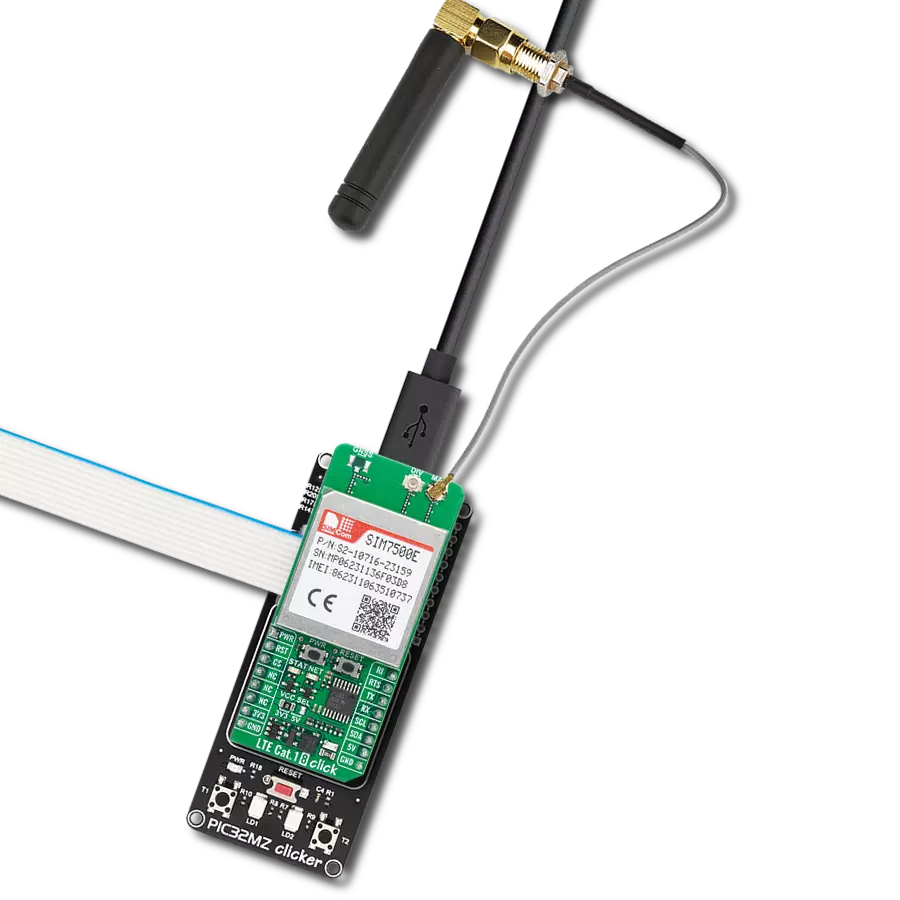
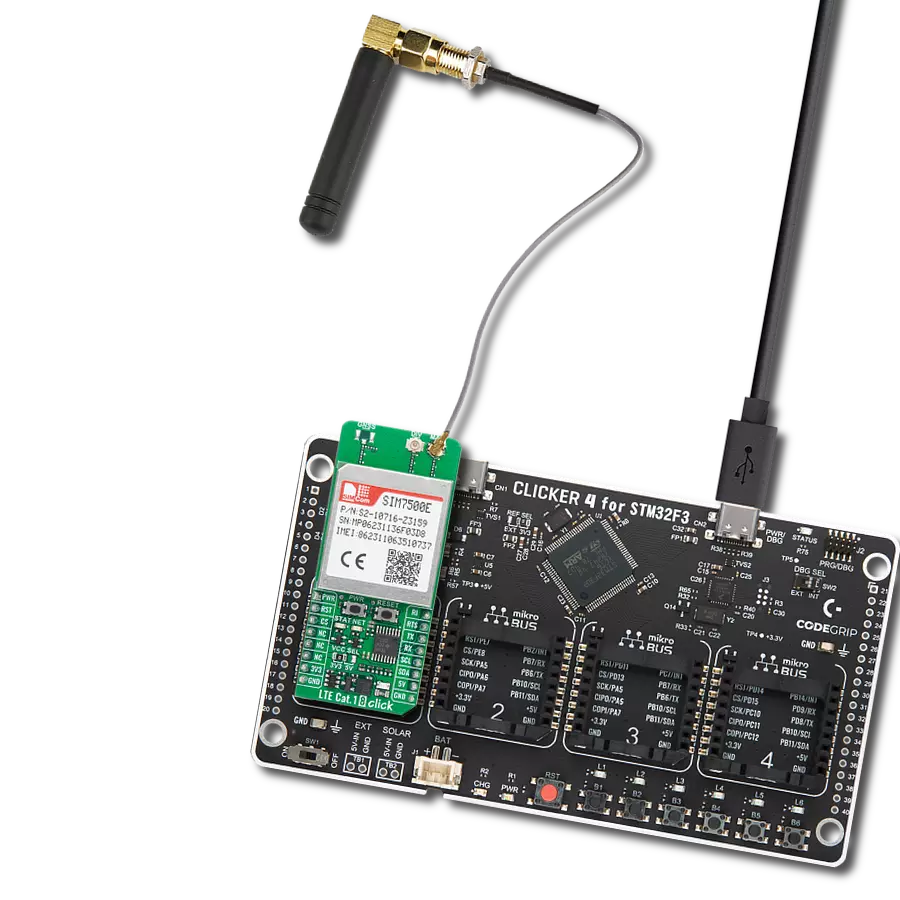
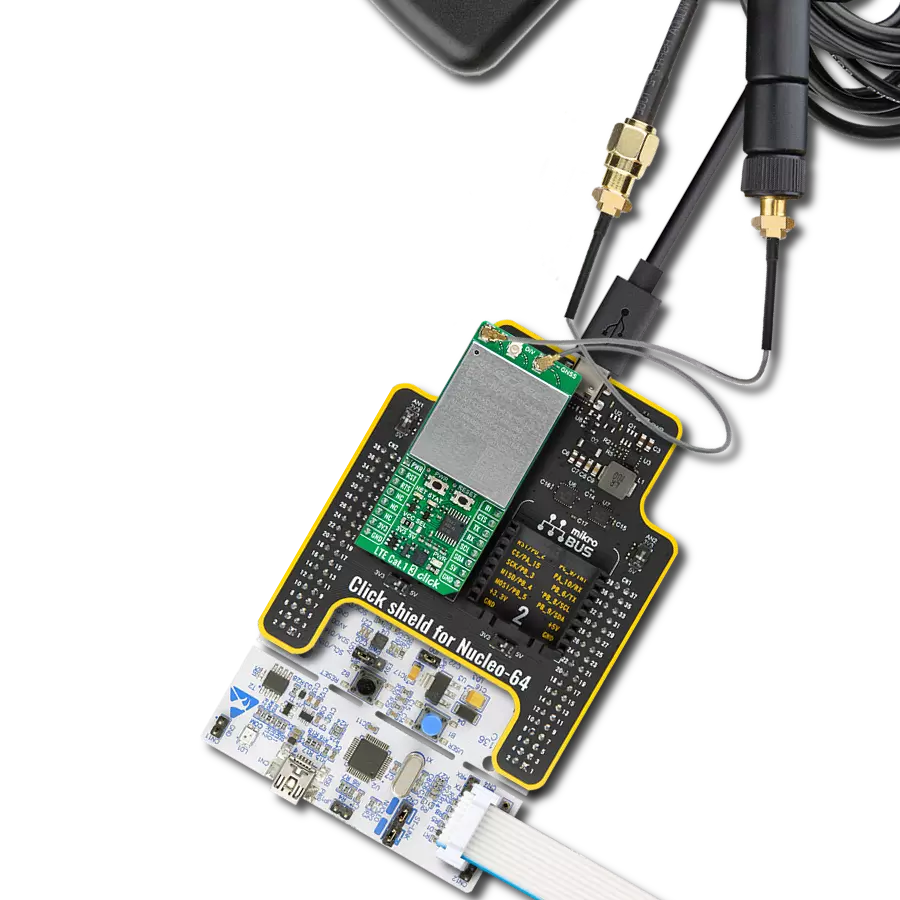
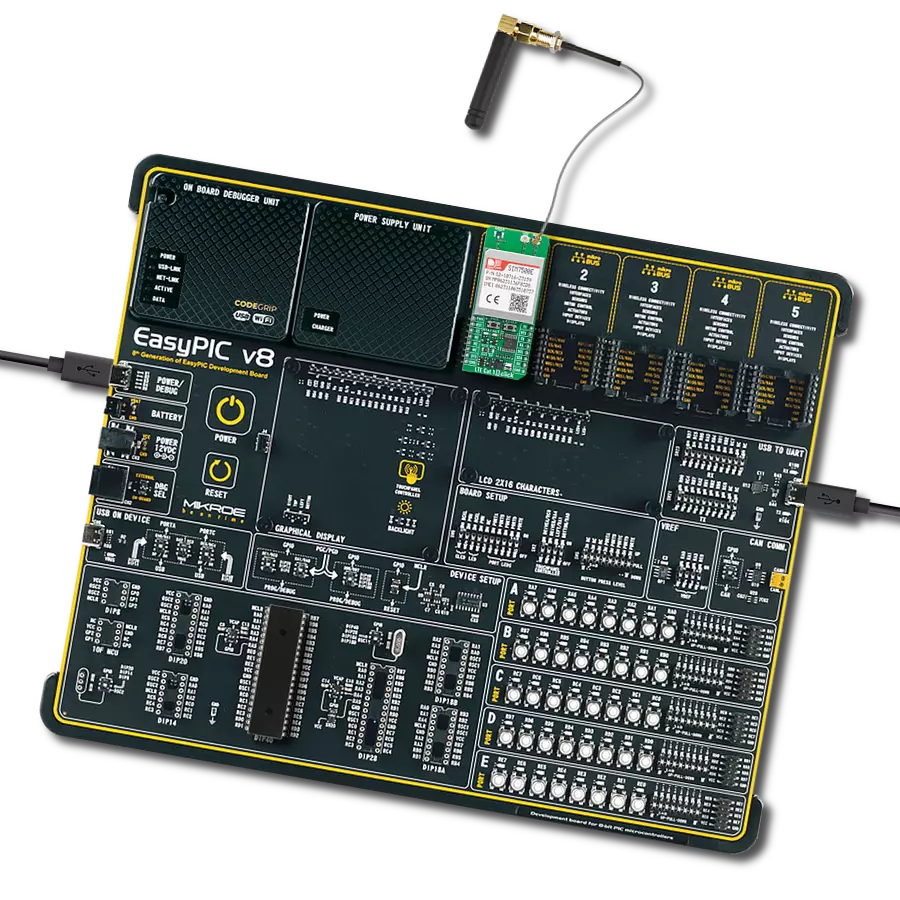
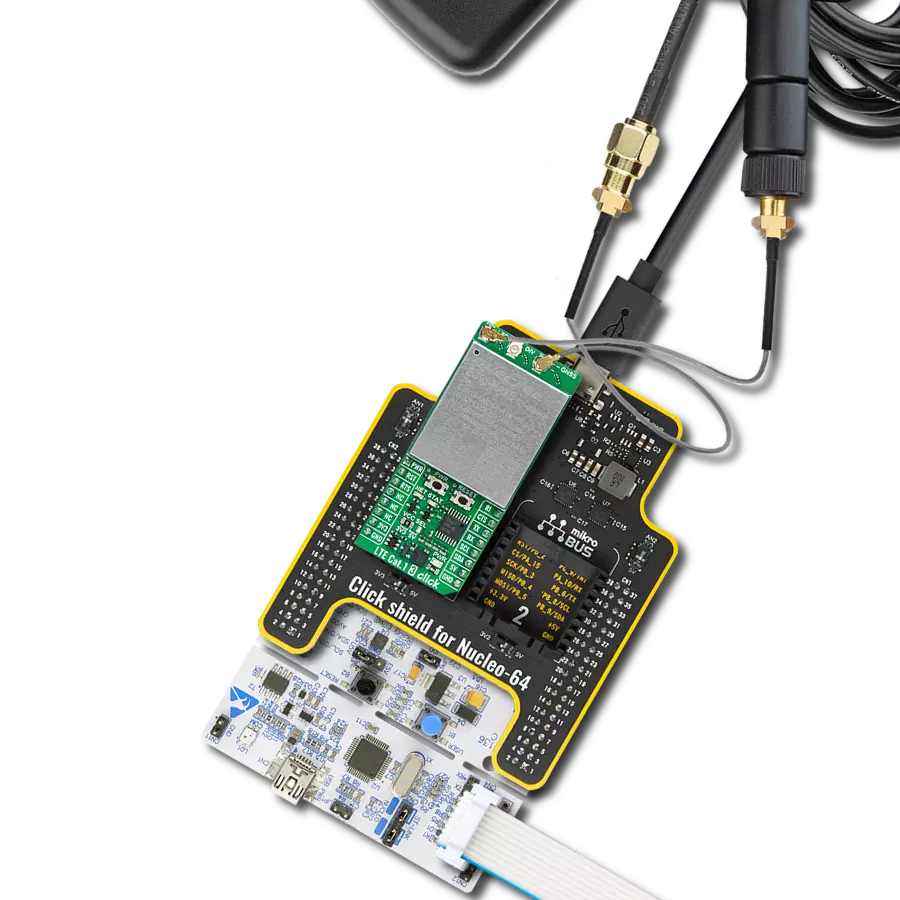
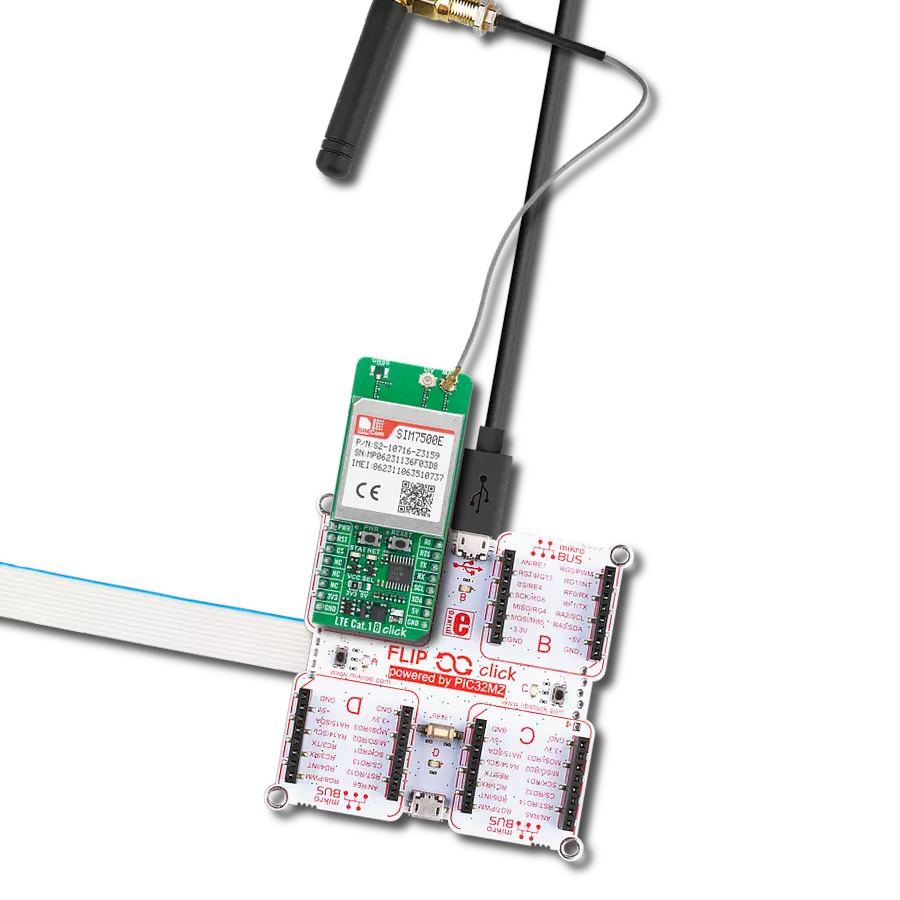
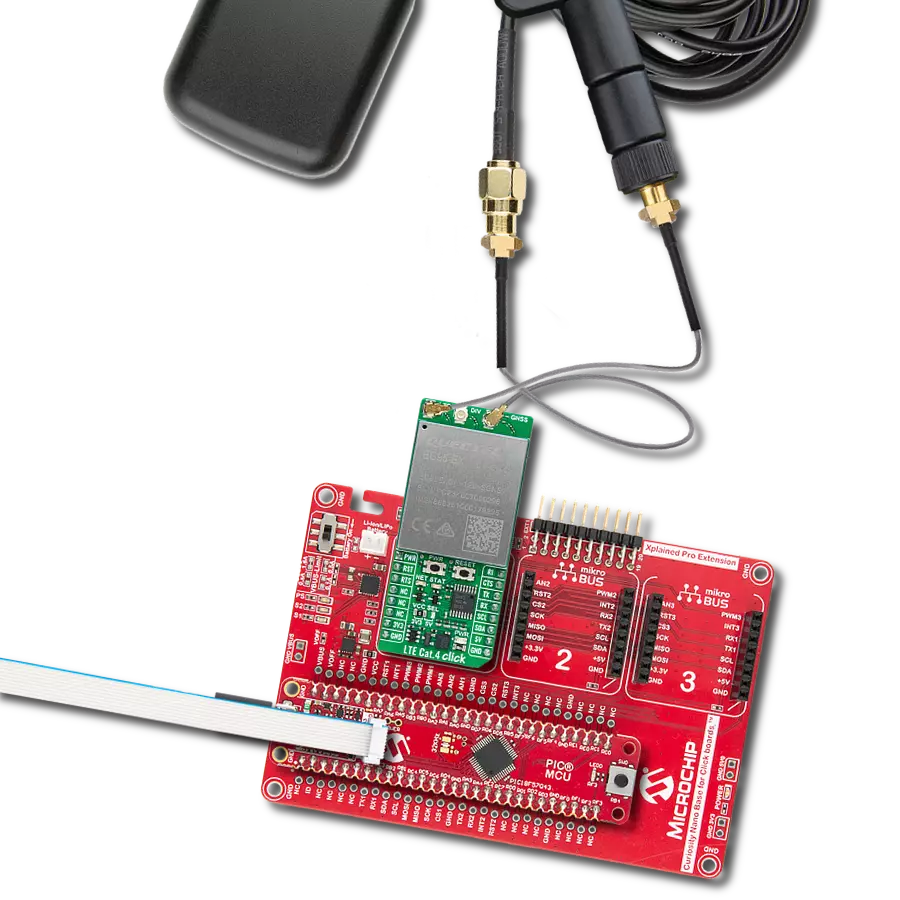
使用EG95EXGA-128-SGNS和PIC18F57Q43实现可靠的4G (LTE)连接,适用于欧洲M2M和物联网
符合3GPP Release 11标准的LTE Cat 4物联网/M2M解决方案
已发布 8月 26, 2024
点击板
LTE Cat.4 Click (for Europe)
开发板
Curiosity Nano with PIC18F57Q43
编译器
NECTO Studio
微控制器单元
PIC18F57Q43
使用LTE Cat 4标准的蜂窝网络连接,适用于欧洲物联网/机器对机器(IoT/M2M)应用中的数据传输
A
A
硬件概览
它是如何工作的?
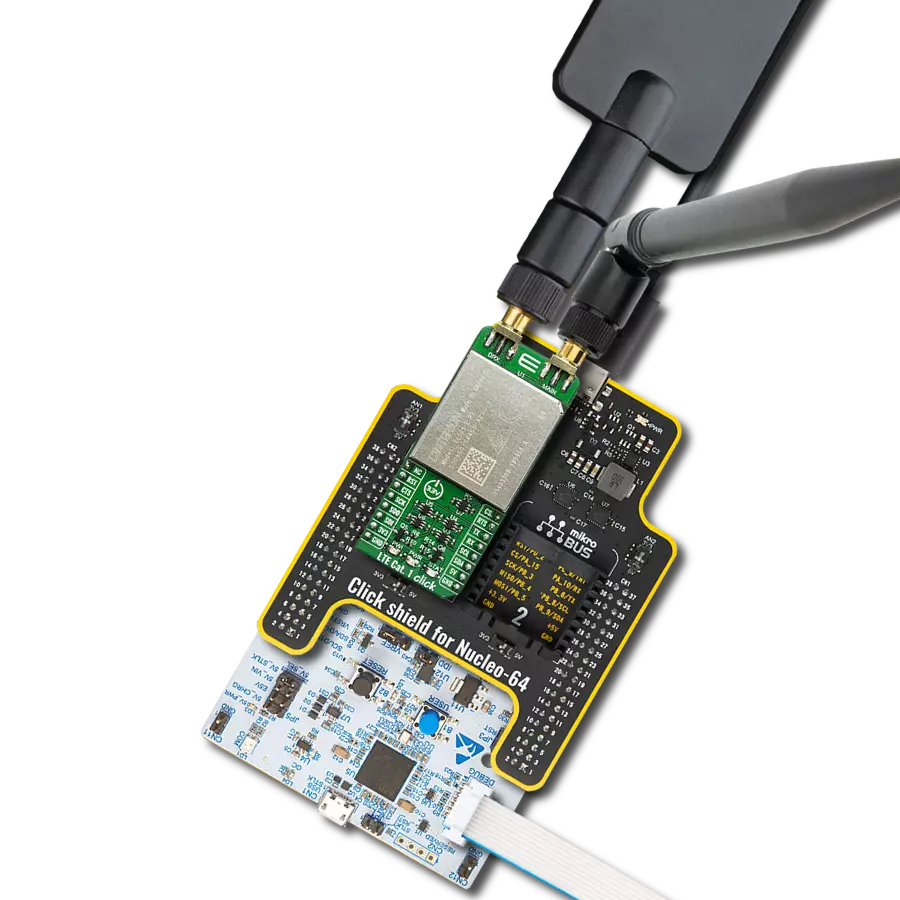
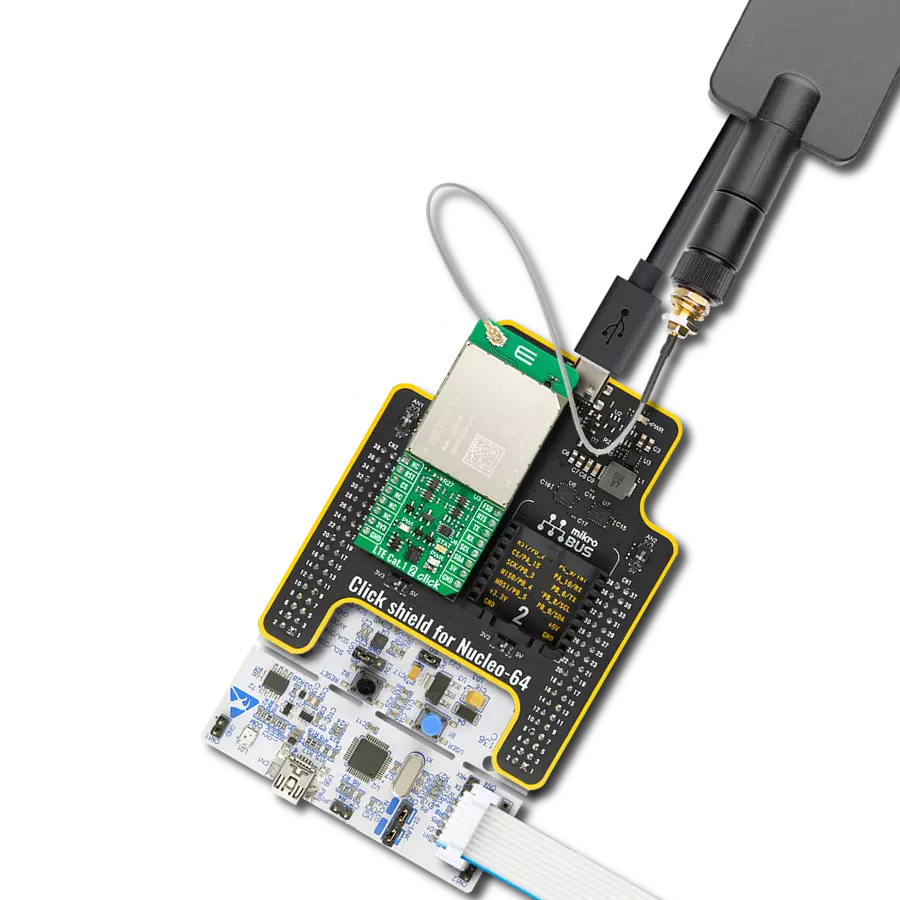
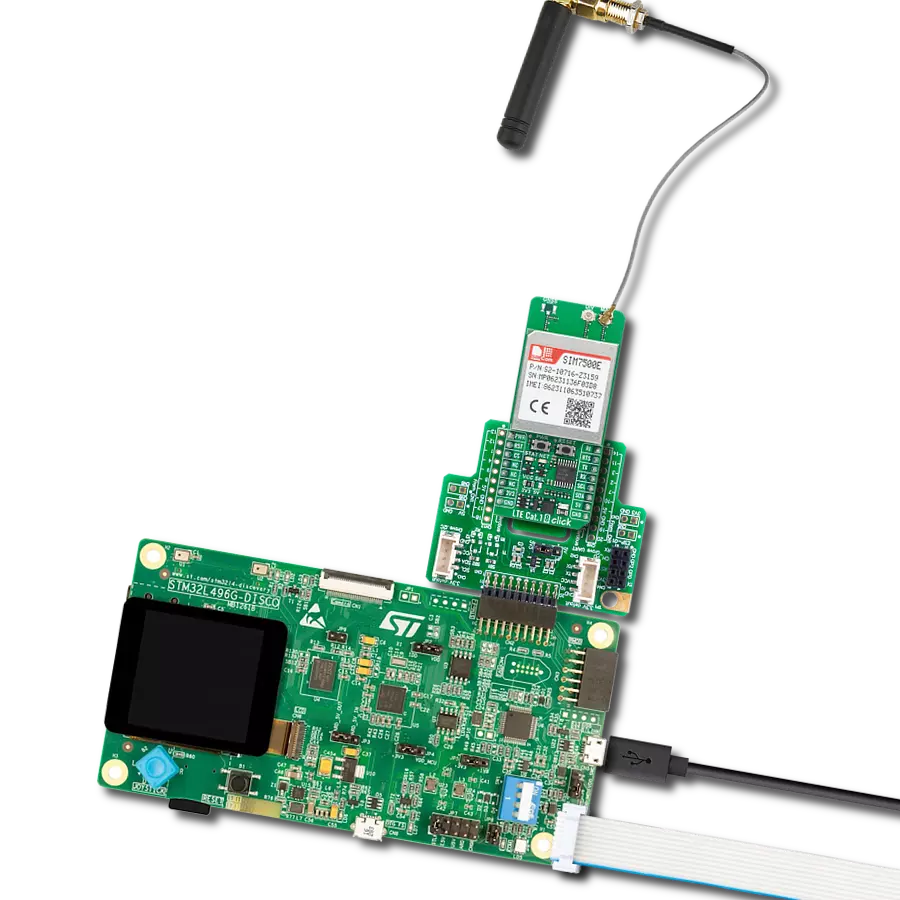
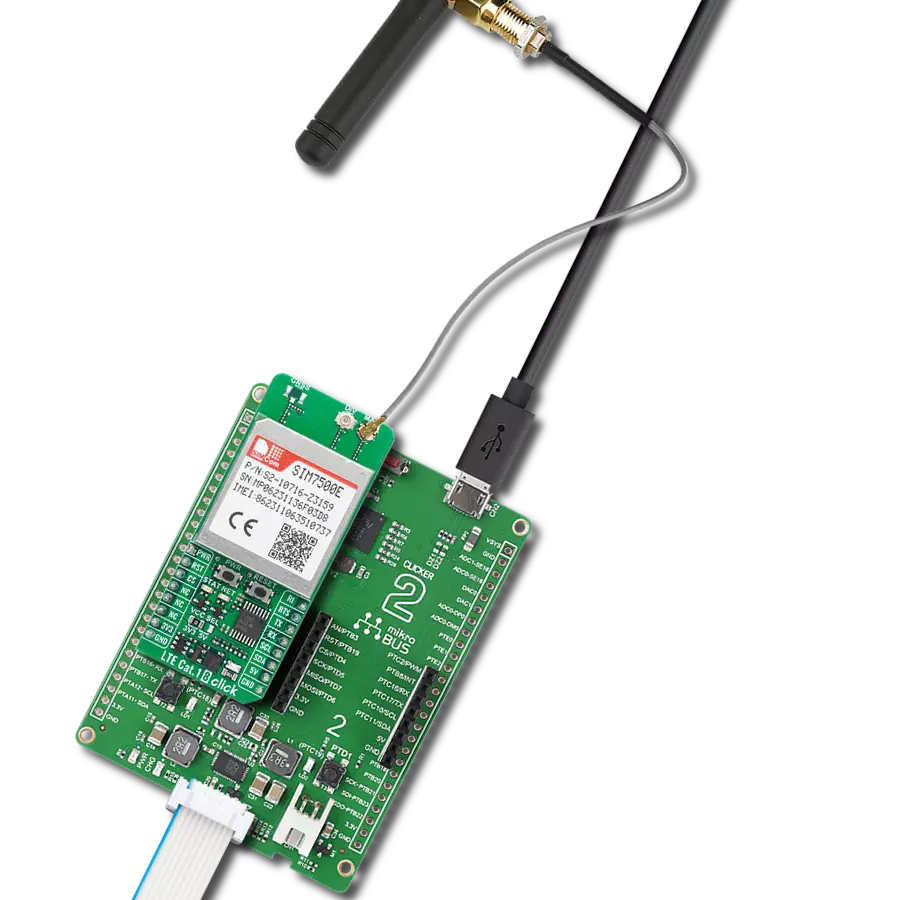
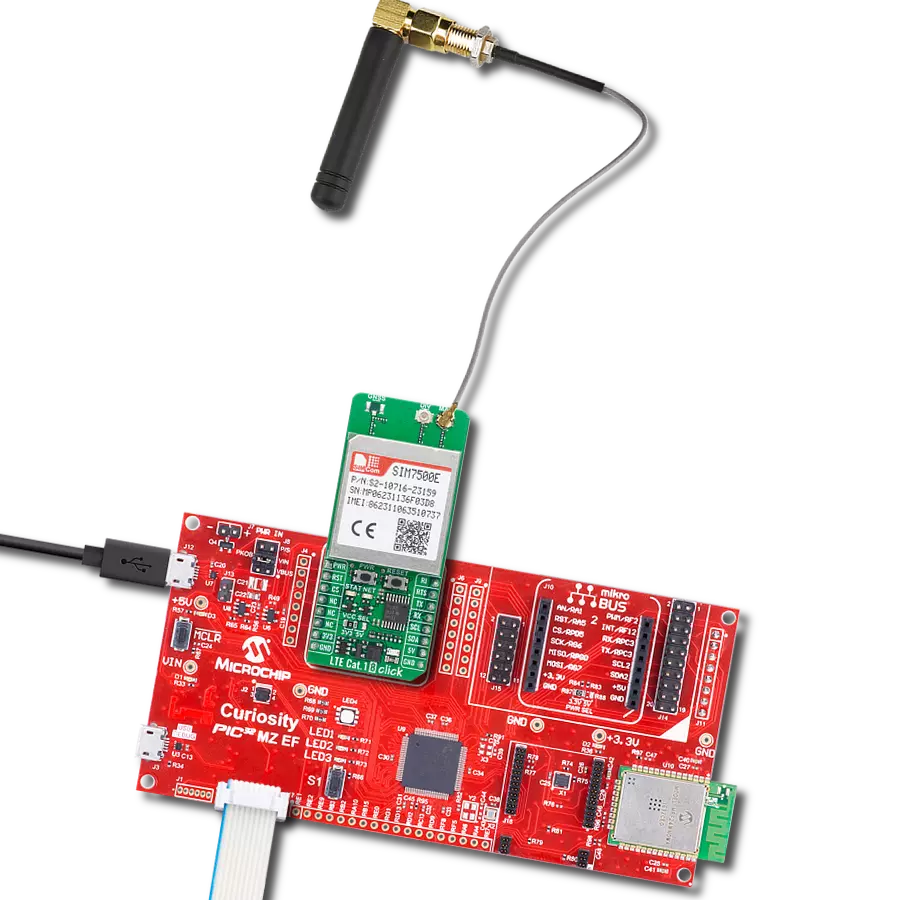
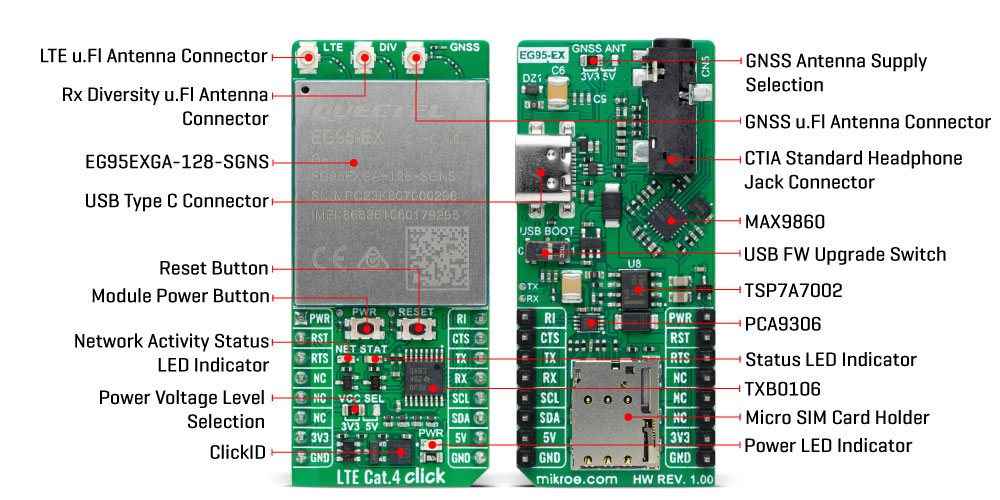
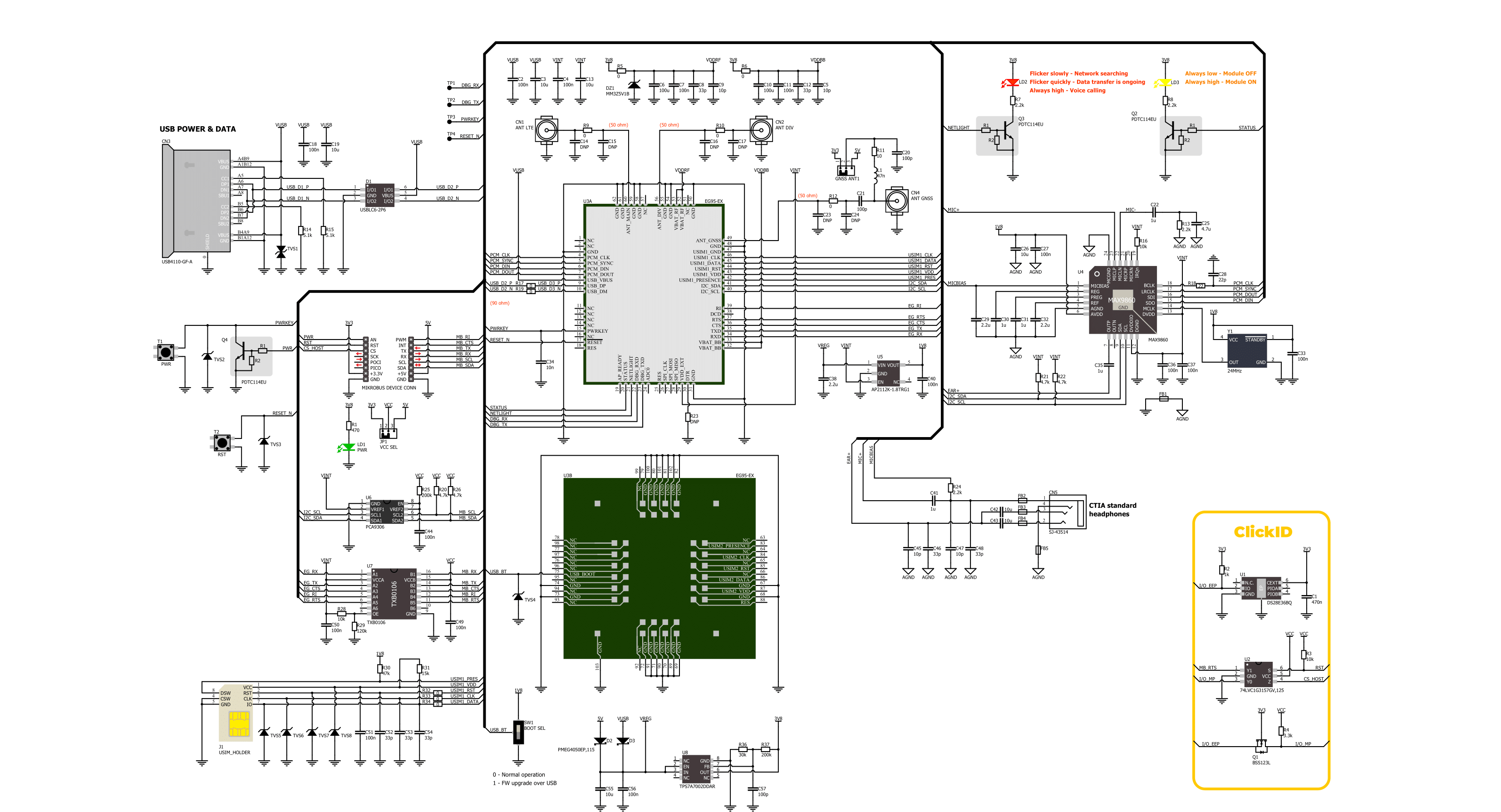
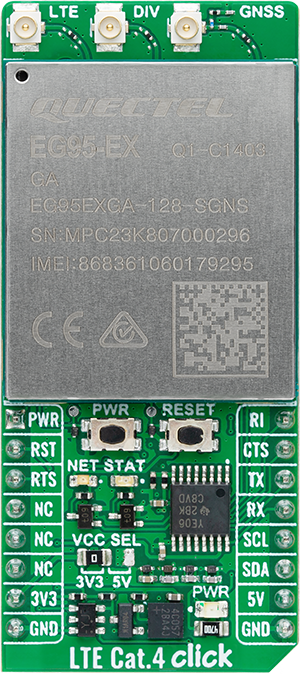
LTE Cat.4 Click 基于 Quectel 的 EG95EXGA-128-SGNS,这是一款面向欧洲地区的IoT/M2M优化的 LTE Cat.4 模块,具有接收分集功能。采用 3GPP Rel. 11 LTE 技术,最大下行数据速率可达 150Mbps,上行数据速率可达 50Mbps。它支持多个 LTE 频段(B1/B3/B7/B8/B20/B28),B1 和 B8 频段的 RX 分集,以及多星座 GNSS 支持,包括 GPS、GLONASS、BeiDou/Compass、Galileo 和 QZSS。该模块完全集成了如 TCP、UDP 和 PPP 等互联网服务协议,使其易于使用扩展的 AT 命令。这些广泛的功能使此 Click board™ 适用于广泛的 M2M 和 IoT 应用,例如工业路由器、工业 PDA、视频监控、数字标牌等。EG95EXGA-128-SGNS 和主机 MCU 之间的通信通过 UART 接口进行,使用标准的 UART RX 和 TX 引脚,以及硬件流控制引脚(CTS/RTS/RI - Clear to Send/Ready to Send/Ring Indicator)以实现高效的数据传输。默认通信速度设置为 115200bps,确保通过 AT 命令进行无缝的数据交换。值得注意的是,此模块版本还具有音频接口,可通过 I2C 接口访问。LTE Cat.4 Click 音频接口通过 MAX9860 操作,这是一款通过 I2C 接口可配置的 16 位单声道音频语音编
解码器。此设置适用于板背面设计用于 CTIA 标准耳机的插孔,这些耳机通常用于现代智能手机,并具有组合音频和麦克风连接器。该标准确保了与各种耳机和耳麦的兼容性。此外,音频接口支持高级功能,如回声消除和噪声抑制,增强了语音通信的清晰度和质量。LTE Cat.4 Click 还包括一个 USB Type C 连接器,用于电源和数据传输,符合 USB 2.0 规范(仅限从设备)。此接口支持高达 480Mbps 的数据传输速率,支持 AT 命令通信、数据传输、GNSS NMEA 语句输出、软件调试、固件升级和通过 USB 的语音通信。板上还配备了一个标记为 USB BOOT 的 USB 固件升级开关,用于管理固件升级。该开关有两个位置:0 为正常操作,1 为通过 USB 进行固件升级,确保了简便的升级过程。此外,此 Click board™ 还包括多项功能,增强了其可用性和控制性。PWR 按钮允许用户轻松开关模块,而 RESET 按钮提供快速重置模块的方法。这些功能还可以通过 mikroBUS™ 引脚 PWR 和 RST 数字控制,提供更大的灵活性。此外,这些控制功能具有专用测试点,便于调试和测试。该板还具有两个视觉指示器,用于提供实时状态更新。红色 NET LED 提供网络活动反馈:当搜索网络时缓
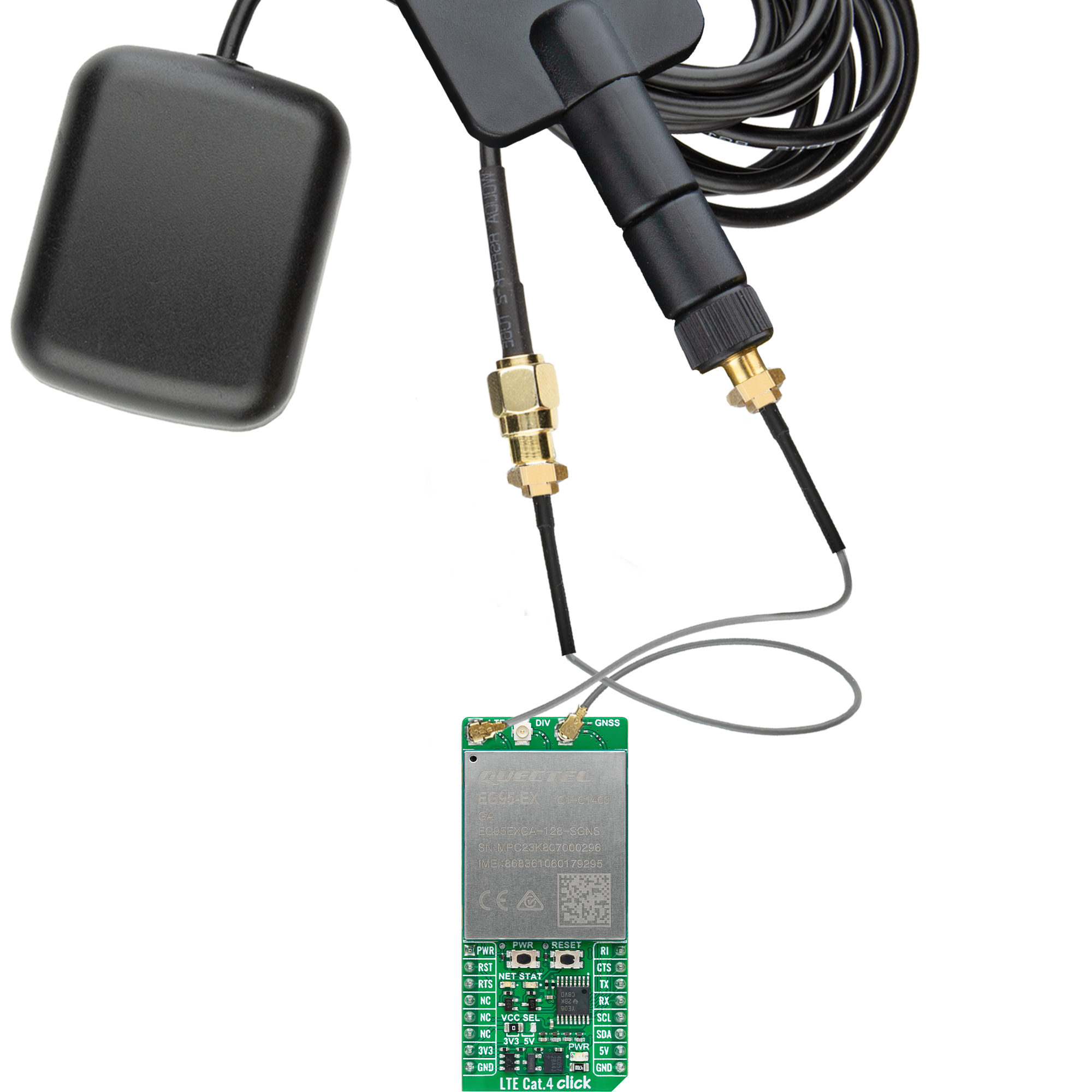
慢闪烁,在数据传输期间快速闪烁,在语音通话期间保持常亮。黄色 STAT LED 指示模块的电源状态,当模块关闭时熄灭,模块打开时点亮。该板还包括用于 UART 调试通信的 DBG TX/RX 接口测试点,简化了开发和故障排除过程。板上具有三个用于 GNSS、LTE 和 LTE/WCDMA RX 分集天线的 u.Fl 连接器,MIKROE 提供的天线包括 LTE 扁平旋转天线和带 IPEX-SMA 电缆的有源 GPS 天线,提供灵活高效的连接选项。此外,用户可以通过 GNSS ANT 跳线轻松选择 GNSS 天线的电源,在 3.3V 和 5V 之间进行选择。板上还配备了一个支持 1.8V 和 3.0V uSIM 卡的 micro SIM 卡座,确保与各种蜂窝网络的兼容性,并允许用户根据特定用例选择最合适的服务提供商。此 Click board™ 可以通过 VCC SEL 跳线选择使用 3.3V 或 5V 逻辑电压水平。由于 EG95EXGA-128-SGNS 模块在 3.8V 下工作,使用逻辑电平转换器 TXB0106 和 PCA9306 以实现正确操作和精确的信号电平转换。因此,3.3V 和 5V 兼容的 MCU 都可以正确使用通信线路。此外,这款 Click board™ 配备了包含易用功能的库和示例代码,可作为进一步开发的参考。
功能概述
开发板
PIC18F57Q43 Curiosity Nano 评估套件是一款尖端的硬件平台,旨在评估 PIC18-Q43 系列内的微控制器。其设计的核心是包含了功能强大的 PIC18F57Q43 微控制器(MCU),提供先进的功能和稳健的性能。这个评估套件的关键特点包括一个黄 色用户 LED 和一个响应灵敏的机械用户开关,提供无
缝的交互和测试。为一个 32.768kHz 水晶振荡器足迹提供支持,确保精准的定时能力。套件内置的调试器拥有一个绿色电源和状态 LED,使编程和调试变得直观高效。此外,增强其实用性的还有虚拟串行端口 (CDC)和一个调试 GPIO 通道(DGI GPIO),提供广泛的连接选项。该套件通过 USB 供电,拥有由
MIC5353 LDO 调节器提供支持的可调目标电压功能,确保在 1.8V 至 5.1V 的输出电压范围内稳定运行,最大输出电流为 500mA,受环境温度和电压限制。

微控制器概述
MCU卡片 / MCU
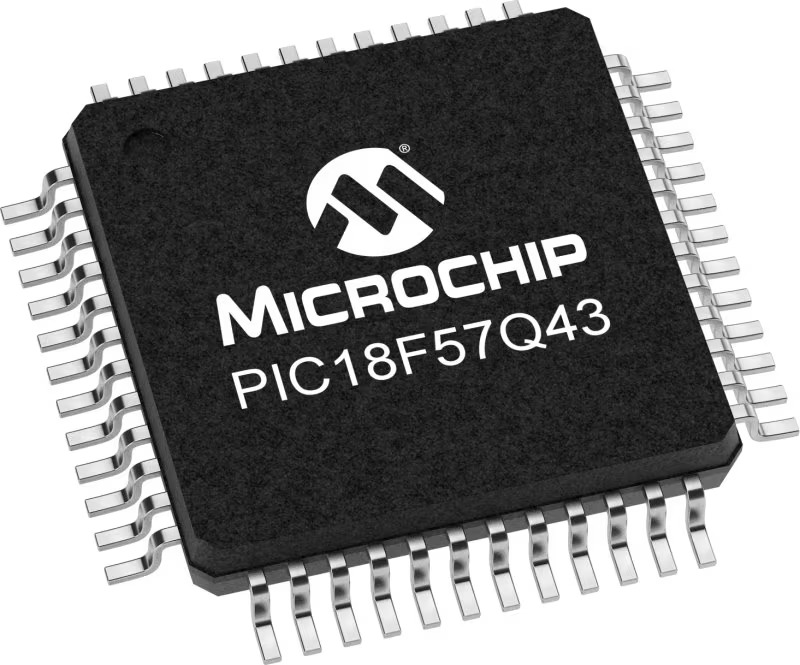
建筑
PIC
MCU 内存 (KB)
128
硅供应商
Microchip
引脚数
48
RAM (字节)
8196
你完善了我!
配件
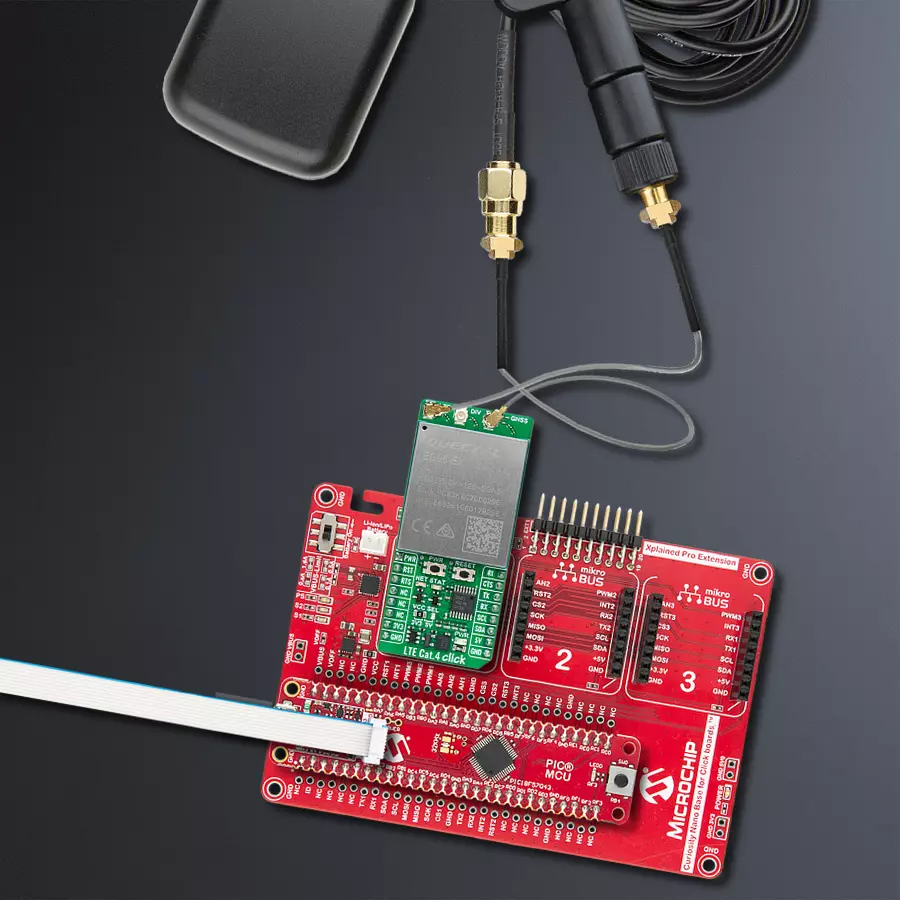
Curiosity Nano Base for Click boards 是一款多功能硬件扩展平台,专为简化 Curiosity Nano 套件与扩展板之间的集成而设计,特别针对符合 mikroBUS™ 标准的 Click 板和 Xplained Pro 扩展板。这款创新的基板(屏蔽板)提供了无缝的连接和扩展可能性,简化了实验和开发过程。主要特点包括从 Curiosity Nano 套件提供 USB 电源兼容性,以及为增强灵活性而提供的另一种外部电源输入选项。板载锂离子/锂聚合物充电器和管理电路确保电池供电应用的平稳运行,简化了使用和管理。此外,基板内置了一个固定的 3.3V 电源供应单元,专用于目标和 mikroBUS™ 电源轨,以及一个固定的 5.0V 升压转换器,专供 mikroBUS™ 插座的 5V 电源轨,为各种连接设备提供稳定的电力供应。

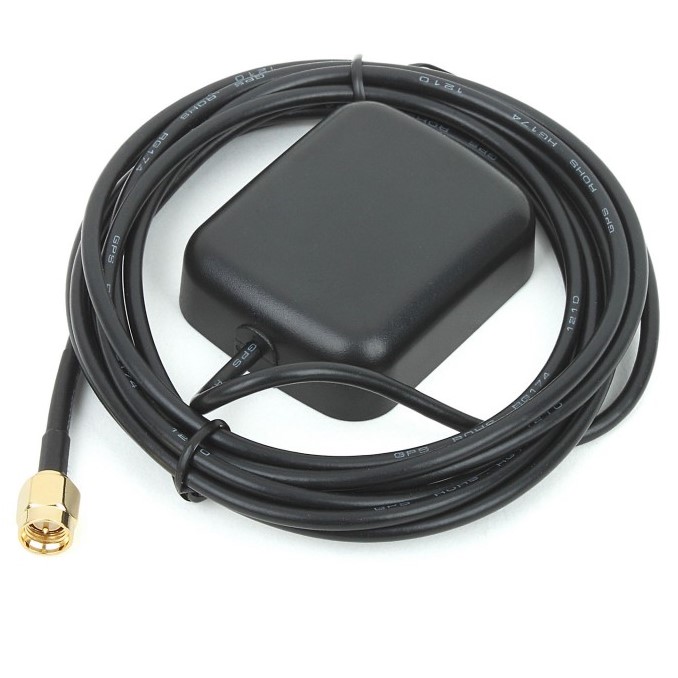
主动 GPS 天线旨在增强您的 GPS 和 GNSS Click 板™ 的性能。这款外置天线结构坚固,适用于各种天气条件。凭借 1575.42MHz 的频率范围和 50Ohm 的阻抗,它确保了可靠的信号接收。天线在较宽的角度范围内提供大于 -4dBic 的增益,确保超过 75% 的覆盖率。± 5MHz 的带宽进一步保证了精确的数据采集。天线采用右旋圆极化 (RHCP),提供稳定的信号接收。其紧凑的尺寸为 48.5×39×15mm,配有 2 米长的电缆,安装方便。磁性天线类型与 SMA 公连接器确保了安全便捷的连接。如果您需要为定位设备提供可靠的外置天线,我们的主动 GPS 天线是完美的解决方案。
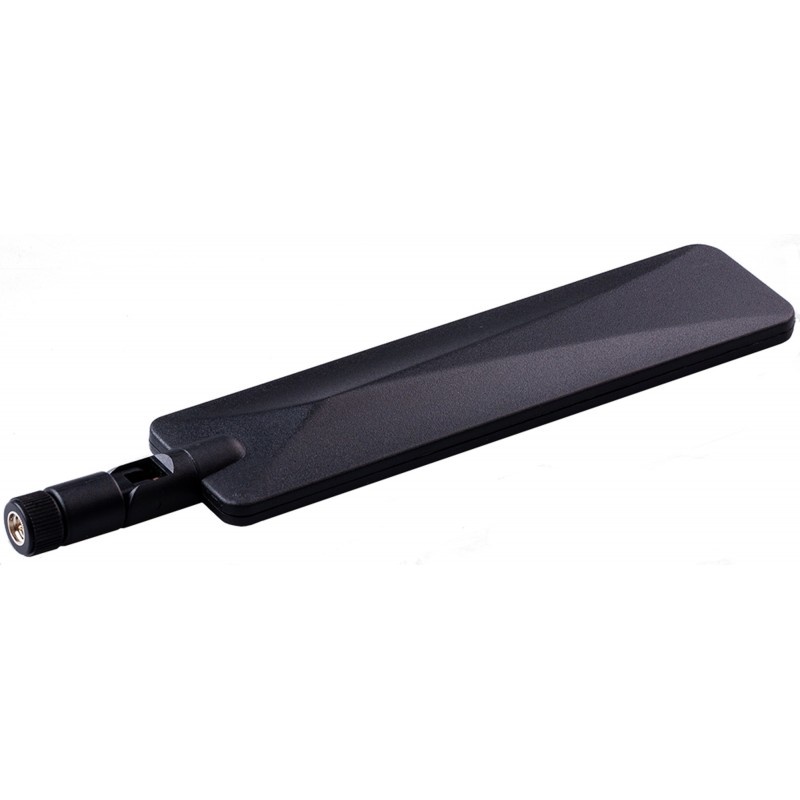
LTE 平板旋转天线是提升 3G/4G LTE 设备性能的多功能选择。其宽频率范围为 700-2700MHz,确保在全球主要蜂窝频段上的最佳连接性。这款平板天线具有 SMA 公连接器,便于直接连接到您的设备或 SMA 模块连接器。其突出特点之一是可调角度,可按 45⁰ 增量设置(0⁰/45⁰/90⁰),允许您微调天线的方向以获得最佳信号接收。凭借 50Ω 的阻抗和 <2.0:1 的 VSW 比率,这款天线确保了可靠且高效的连接。其 5dB 增益、垂直极化和全向辐射模式增强了信号强度,适用于各种应用。天线尺寸为 196mm 长和 38mm 宽,提供紧凑且有效的连接解决方案。最大输入功率为 50W,能够满足各种设备的需求。
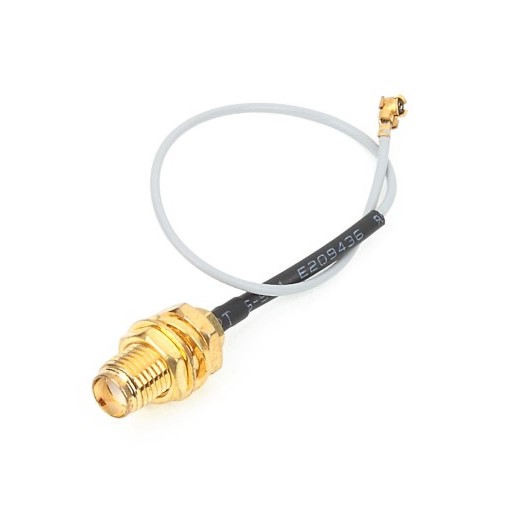
IPEX-SMA 电缆是一种射频(RF)电缆组件。"IPEX" 指的是 IPEX 连接器,这是一种常用于小型电子设备中的微型同轴连接器。"SMA" 代表 SubMiniature Version A,是另一种常用于 RF 应用的同轴连接器。IPEX-SMA 电缆组件在一端具有 IPEX 连接器,另一端具有 SMA 连接器,使其能够连接使用这些特定连接器的设备或组件。这些电缆通常用于 WiFi 或蜂窝天线、GPS 模块以及其他需要可靠且低损耗连接的射频通信系统中的应用。
使用的MCU引脚
mikroBUS™映射器
“仔细看看!”
Click board™ 原理图
一步一步来
项目组装

从选择您的开发板和Click板™开始。以Curiosity Nano with PIC18F57Q43作为您的开发板开始。




实时跟踪您的结果
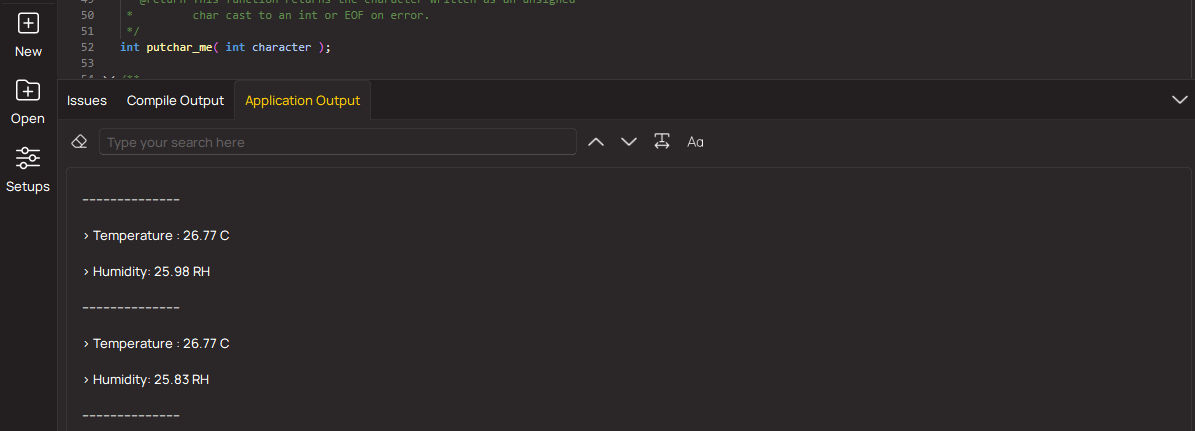
应用程序输出
1. 应用程序输出 - 在调试模式下,“应用程序输出”窗口支持实时数据监控,直接提供执行结果的可视化。请按照提供的教程正确配置环境,以确保数据正确显示。
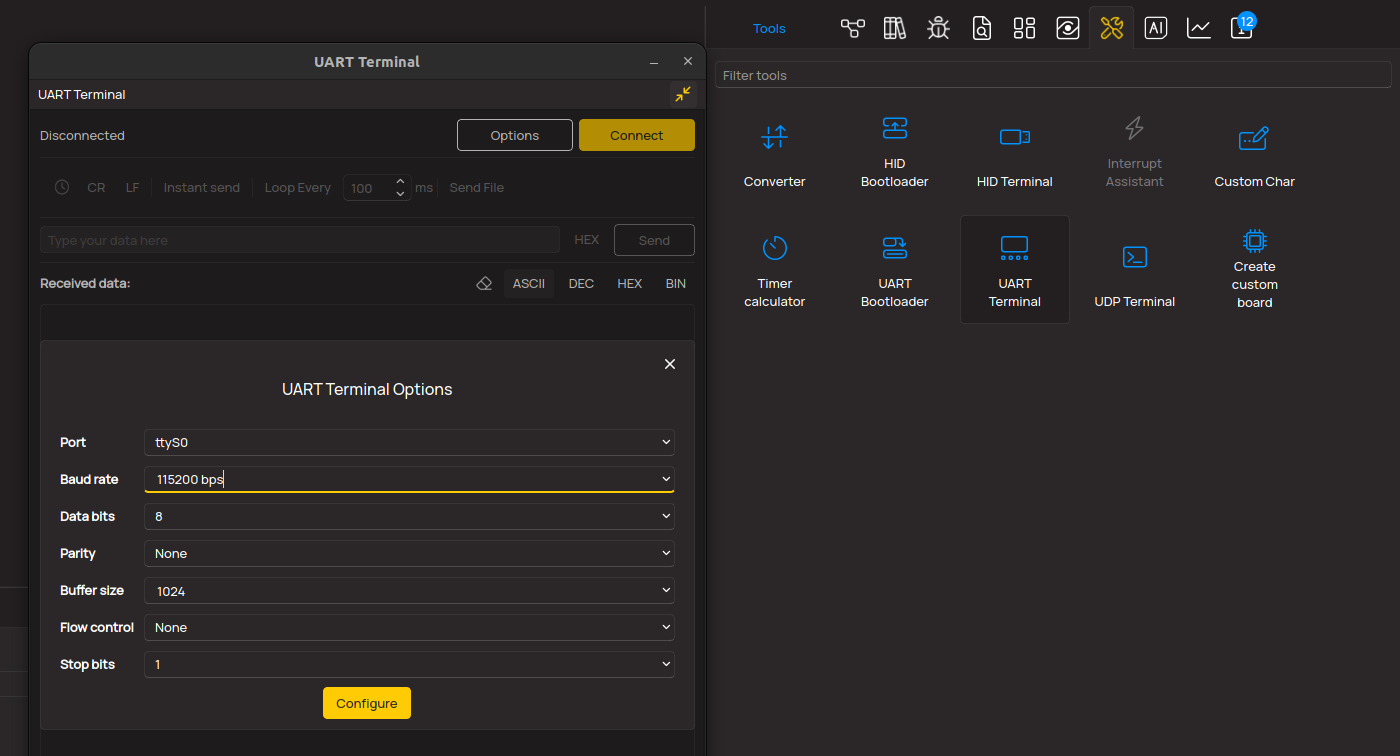
2. UART 终端 - 使用UART Terminal通过USB to UART converter监视数据传输,实现Click board™与开发系统之间的直接通信。请根据项目需求配置波特率和其他串行设置,以确保正常运行。有关分步设置说明,请参考提供的教程。
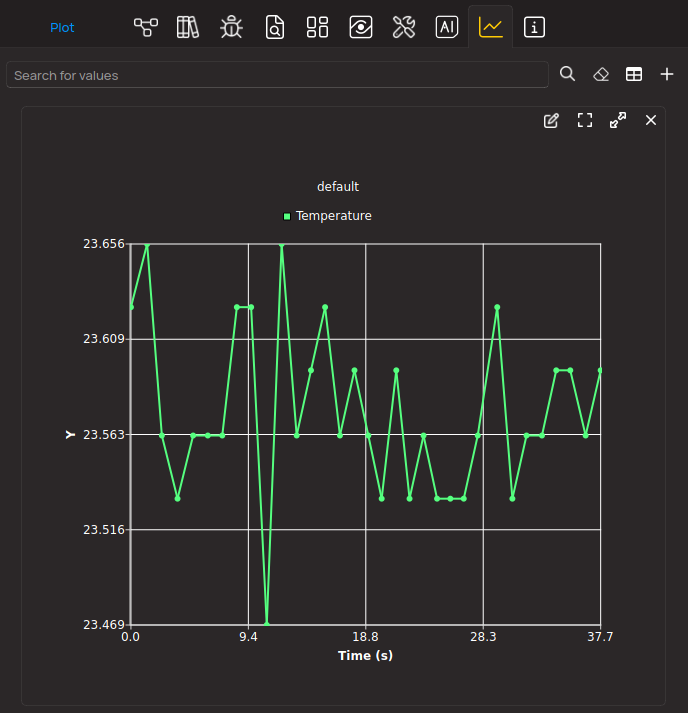
3. Plot 输出 - Plot功能提供了一种强大的方式来可视化实时传感器数据,使趋势分析、调试和多个数据点的对比变得更加直观。要正确设置,请按照提供的教程,其中包含使用Plot功能显示Click board™读数的分步示例。在代码中使用Plot功能时,请使用以下函数:plot(insert_graph_name, variable_name);。这是一个通用格式,用户需要将“insert_graph_name”替换为实际图表名称,并将“variable_name”替换为要显示的参数。
软件支持
库描述
该库包含 LTE Cat.4 Click (for Europe) 驱动程序的 API。
关键功能:
ltecat4_set_sim_apn- 此函数为SIM卡设置APN。ltecat4_send_sms_text- 此函数向电话号码发送文本消息。ltecat4_send_cmd- 此函数向Click模块发送指定的命令。
开源
代码示例
完整的应用程序代码和一个现成的项目可以通过NECTO Studio包管理器直接安装到NECTO Studio。 应用程序代码也可以在MIKROE的GitHub账户中找到。
/*!
* @file main.c
* @brief LTE Cat.4 Click Example.
*
* # Description
* Application example shows device capability of connecting to the network and
* sending SMS or TCP/UDP messages, answering incoming calls, or retrieving data
* from GNSS using standard "AT" commands.
*
* The demo application is composed of two sections :
*
* ## Application Init
* Initializes the driver and logger.
*
* ## Application Task
* Application task is split in few stages:
* - LTECAT4_POWER_UP:
* Powers up the device, performs a factory reset and reads system information.
*
* - LTECAT4_CONFIG_CONNECTION:
* Sets configuration to device to be able to connect to the network
* (used only for SMS, CALL, or TCP/UDP demo examples).
*
* - LTECAT4_CHECK_CONNECTION:
* Waits for the network registration indicated via CREG command and then checks
* the signal quality report (used only for SMS, CALL, or TCP/UDP demo examples).
*
* - LTECAT4_CONFIG_EXAMPLE:
* Configures device for the selected example.
*
* - LTECAT4_EXAMPLE:
* Depending on the selected demo example, it sends an SMS message (in PDU or TXT mode)
* or TCP/UDP message, waits for incoming calls and answers it, or waits for the GPS fix
* to retrieve location info from GNSS.
*
* By default, the TCP/UDP example is selected.
*
* ## Additional Function
* - static void ltecat4_clear_app_buf ( void )
* - static void ltecat4_log_app_buf ( void )
* - static err_t ltecat4_process ( ltecat4_t *ctx )
* - static err_t ltecat4_read_response ( ltecat4_t *ctx, uint8_t *rsp )
* - static err_t ltecat4_power_up ( ltecat4_t *ctx )
* - static err_t ltecat4_config_connection ( ltecat4_t *ctx )
* - static err_t ltecat4_check_connection ( ltecat4_t *ctx )
* - static err_t ltecat4_config_example ( ltecat4_t *ctx )
* - static err_t ltecat4_example ( ltecat4_t *ctx )
*
* @note
* In order for the examples to work (except GNSS example), user needs to set the APN and SMSC (SMS PDU mode only)
* of entered SIM card as well as the phone number (SMS mode only) to which he wants to send an SMS.
* Enter valid values for the following macros: SIM_APN, SIM_SMSC and PHONE_NUMBER.
* Example:
SIM_APN "internet"
SIM_SMSC "+381610401"
PHONE_NUMBER "+381659999999"
*
* @author Stefan Filipovic
*
*/
#include "board.h"
#include "log.h"
#include "ltecat4.h"
#include "conversions.h"
// Example selection macros
#define EXAMPLE_TCP_UDP 0 // Example of sending messages to a TCP/UDP echo server
#define EXAMPLE_SMS 1 // Example of sending SMS to a phone number
#define EXAMPLE_CALL 2 // Example of answering incoming calls
#define EXAMPLE_GNSS 3 // Example of retrieving location info from GNSS
#define DEMO_EXAMPLE EXAMPLE_TCP_UDP // Example selection macro
// SIM APN config
#define SIM_APN "internet" // Set valid SIM APN
// SMS example parameters
#define SIM_SMSC "" // Set valid SMS Service Center Address - only in SMS PDU mode
#define PHONE_NUMBER "" // Set Phone number to message
#define SMS_MODE "1" // SMS mode: "0" - PDU, "1" - TXT
// TCP/UDP example parameters
#define REMOTE_IP "77.46.162.162" // TCP/UDP echo server IP address
#define REMOTE_PORT "51111" // TCP/UDP echo server port
// Message content
#define MESSAGE_CONTENT "LTE Cat.4 Click board - demo example."
// Application buffer size
#define APP_BUFFER_SIZE 256
#define PROCESS_BUFFER_SIZE 256
/**
* @brief Example states.
* @details Predefined enum values for application example state.
*/
typedef enum
{
LTECAT4_POWER_UP = 1,
LTECAT4_CONFIG_CONNECTION,
LTECAT4_CHECK_CONNECTION,
LTECAT4_CONFIG_EXAMPLE,
LTECAT4_EXAMPLE
} ltecat4_app_state_t;
/**
* @brief Application example variables.
* @details Variables used in application example.
*/
static uint8_t app_buf[ APP_BUFFER_SIZE ] = { 0 };
static int32_t app_buf_len = 0;
static ltecat4_app_state_t app_state = LTECAT4_POWER_UP;
static ltecat4_t ltecat4;
static log_t logger;
/**
* @brief LTE Cat.4 clearing application buffer.
* @details This function clears memory of application buffer and reset its length.
* @note None.
*/
static void ltecat4_clear_app_buf ( void );
/**
* @brief LTE Cat.4 log application buffer.
* @details This function logs data from application buffer to USB UART.
* @note None.
*/
static void ltecat4_log_app_buf ( void );
/**
* @brief LTE Cat.4 data reading function.
* @details This function reads data from device and concatenates data to application buffer.
* @param[in] ctx : Click context object.
* See #ltecat4_t object definition for detailed explanation.
* @return @li @c 0 - Read some data.
* @li @c -1 - Nothing is read.
* See #err_t definition for detailed explanation.
* @note None.
*/
static err_t ltecat4_process ( ltecat4_t *ctx );
/**
* @brief LTE Cat.4 read response function.
* @details This function waits for a response message, reads and displays it on the USB UART.
* @param[in] ctx : Click context object.
* See #ltecat4_t object definition for detailed explanation.
* @param[in] rsp Expected response.
* @return @li @c 0 - OK response.
* @li @c -2 - Timeout error.
* @li @c -3 - Command error.
* @li @c -4 - Unknown error.
* See #err_t definition for detailed explanation.
* @note None.
*/
static err_t ltecat4_read_response ( ltecat4_t *ctx, uint8_t *rsp );
/**
* @brief LTE Cat.4 power up function.
* @details This function powers up the device, performs a factory reset and reads system information.
* @param[in] ctx : Click context object.
* See #ltecat4_t object definition for detailed explanation.
* @return @li @c 0 - OK.
* @li @c != 0 - Read response error.
* See #err_t definition for detailed explanation.
* @note None.
*/
static err_t ltecat4_power_up ( ltecat4_t *ctx );
/**
* @brief LTE Cat.4 config connection function.
* @details This function configures and enables connection to the specified network.
* @param[in] ctx : Click context object.
* See #ltecat4_t object definition for detailed explanation.
* @return @li @c 0 - OK.
* @li @c != 0 - Read response error.
* See #err_t definition for detailed explanation.
* @note None.
*/
static err_t ltecat4_config_connection ( ltecat4_t *ctx );
/**
* @brief LTE Cat.4 check connection function.
* @details This function checks the connection to network.
* @param[in] ctx : Click context object.
* See #ltecat4_t object definition for detailed explanation.
* @return @li @c 0 - OK.
* @li @c != 0 - Read response error.
* See #err_t definition for detailed explanation.
* @note None.
*/
static err_t ltecat4_check_connection ( ltecat4_t *ctx );
/**
* @brief LTE Cat.4 config example function.
* @details This function configures device for the selected example.
* @param[in] ctx : Click context object.
* See #ltecat4_t object definition for detailed explanation.
* @return @li @c 0 - OK.
* @li @c != 0 - Read response error.
* See #err_t definition for detailed explanation.
* @note None.
*/
static err_t ltecat4_config_example ( ltecat4_t *ctx );
/**
* @brief LTE Cat.4 example function.
* @details This function executes SMS, TCP/UDP, CALL, or GNSS example depending on the DEMO_EXAMPLE macro.
* @param[in] ctx : Click context object.
* See #ltecat4_t object definition for detailed explanation.
* @return @li @c 0 - OK.
* @li @c != 0 - Read response error.
* See #err_t definition for detailed explanation.
* @note None.
*/
static err_t ltecat4_example ( ltecat4_t *ctx );
void application_init ( void )
{
log_cfg_t log_cfg; /**< Logger config object. */
ltecat4_cfg_t ltecat4_cfg; /**< Click config object. */
/**
* Logger initialization.
* Default baud rate: 115200
* Default log level: LOG_LEVEL_DEBUG
* @note If USB_UART_RX and USB_UART_TX
* are defined as HAL_PIN_NC, you will
* need to define them manually for log to work.
* See @b LOG_MAP_USB_UART macro definition for detailed explanation.
*/
LOG_MAP_USB_UART( log_cfg );
log_init( &logger, &log_cfg );
log_info( &logger, " Application Init " );
// Click initialization.
ltecat4_cfg_setup( <ecat4_cfg );
LTECAT4_MAP_MIKROBUS( ltecat4_cfg, MIKROBUS_1 );
if ( UART_ERROR == ltecat4_init( <ecat4, <ecat4_cfg ) )
{
log_error( &logger, " Communication init." );
for ( ; ; );
}
log_info( &logger, " Application Task " );
app_state = LTECAT4_POWER_UP;
log_printf( &logger, ">>> APP STATE - POWER UP <<<\r\n\n" );
}
void application_task ( void )
{
switch ( app_state )
{
case LTECAT4_POWER_UP:
{
if ( LTECAT4_OK == ltecat4_power_up( <ecat4 ) )
{
app_state = LTECAT4_CONFIG_CONNECTION;
log_printf( &logger, ">>> APP STATE - CONFIG CONNECTION <<<\r\n\n" );
}
break;
}
case LTECAT4_CONFIG_CONNECTION:
{
if ( LTECAT4_OK == ltecat4_config_connection( <ecat4 ) )
{
app_state = LTECAT4_CHECK_CONNECTION;
log_printf( &logger, ">>> APP STATE - CHECK CONNECTION <<<\r\n\n" );
}
break;
}
case LTECAT4_CHECK_CONNECTION:
{
if ( LTECAT4_OK == ltecat4_check_connection( <ecat4 ) )
{
app_state = LTECAT4_CONFIG_EXAMPLE;
log_printf( &logger, ">>> APP STATE - CONFIG EXAMPLE <<<\r\n\n" );
}
break;
}
case LTECAT4_CONFIG_EXAMPLE:
{
if ( LTECAT4_OK == ltecat4_config_example( <ecat4 ) )
{
app_state = LTECAT4_EXAMPLE;
log_printf( &logger, ">>> APP STATE - EXAMPLE <<<\r\n\n" );
}
break;
}
case LTECAT4_EXAMPLE:
{
ltecat4_example( <ecat4 );
break;
}
default:
{
log_error( &logger, " APP STATE." );
break;
}
}
}
int main ( void )
{
/* Do not remove this line or clock might not be set correctly. */
#ifdef PREINIT_SUPPORTED
preinit();
#endif
application_init( );
for ( ; ; )
{
application_task( );
}
return 0;
}
static void ltecat4_clear_app_buf ( void )
{
memset( app_buf, 0, app_buf_len );
app_buf_len = 0;
}
static void ltecat4_log_app_buf ( void )
{
for ( int32_t buf_cnt = 0; buf_cnt < app_buf_len; buf_cnt++ )
{
log_printf( &logger, "%c", app_buf[ buf_cnt ] );
}
}
static err_t ltecat4_process ( ltecat4_t *ctx )
{
uint8_t rx_buf[ PROCESS_BUFFER_SIZE ] = { 0 };
int32_t overflow_bytes = 0;
int32_t rx_cnt = 0;
int32_t rx_size = ltecat4_generic_read( ctx, rx_buf, PROCESS_BUFFER_SIZE );
if ( ( rx_size > 0 ) && ( rx_size <= APP_BUFFER_SIZE ) )
{
if ( ( app_buf_len + rx_size ) > APP_BUFFER_SIZE )
{
overflow_bytes = ( app_buf_len + rx_size ) - APP_BUFFER_SIZE;
app_buf_len = APP_BUFFER_SIZE - rx_size;
memmove ( app_buf, &app_buf[ overflow_bytes ], app_buf_len );
memset ( &app_buf[ app_buf_len ], 0, overflow_bytes );
}
for ( rx_cnt = 0; rx_cnt < rx_size; rx_cnt++ )
{
if ( rx_buf[ rx_cnt ] )
{
app_buf[ app_buf_len++ ] = rx_buf[ rx_cnt ];
}
}
return LTECAT4_OK;
}
return LTECAT4_ERROR;
}
static err_t ltecat4_read_response ( ltecat4_t *ctx, uint8_t *rsp )
{
#define READ_RESPONSE_TIMEOUT_MS 120000
uint32_t timeout_cnt = 0;
ltecat4_clear_app_buf ( );
ltecat4_process( ctx );
while ( ( 0 == strstr( app_buf, rsp ) ) &&
( 0 == strstr( app_buf, LTECAT4_RSP_ERROR ) ) )
{
ltecat4_process( ctx );
if ( timeout_cnt++ > READ_RESPONSE_TIMEOUT_MS )
{
ltecat4_clear_app_buf( );
log_error( &logger, " Timeout!" );
return LTECAT4_ERROR_TIMEOUT;
}
Delay_ms( 1 );
}
Delay_ms ( 200 );
ltecat4_process( ctx );
if ( strstr( app_buf, rsp ) )
{
ltecat4_log_app_buf( );
log_printf( &logger, "--------------------------------\r\n" );
return LTECAT4_OK;
}
else if ( strstr( app_buf, LTECAT4_RSP_ERROR ) )
{
log_error( &logger, " CMD!" );
return LTECAT4_ERROR_CMD;
}
log_error( &logger, " Unknown!" );
return LTECAT4_ERROR_UNKNOWN;
}
static err_t ltecat4_power_up ( ltecat4_t *ctx )
{
err_t error_flag = LTECAT4_OK;
for ( ; ; )
{
ltecat4_process( ctx );
ltecat4_clear_app_buf ( );
// Wake up UART interface
ltecat4_send_cmd( ctx, LTECAT4_CMD_AT );
log_printf( &logger, ">>> Check communication.\r\n" );
ltecat4_send_cmd( ctx, LTECAT4_CMD_AT );
if ( ( ( LTECAT4_OK == ltecat4_process( ctx ) ) && strstr( app_buf, LTECAT4_RSP_OK ) ) )
{
break;
}
else
{
log_printf( &logger, ">>> Power up device.\r\n" );
ltecat4_set_power_state ( ctx, LTECAT4_POWER_STATE_ON );
}
}
ltecat4_send_cmd( ctx, LTECAT4_CMD_AT );
error_flag |= ltecat4_read_response( ctx, LTECAT4_RSP_OK );
log_printf( &logger, ">>> Factory reset.\r\n" );
ltecat4_send_cmd( ctx, LTECAT4_CMD_FACTORY_RESET );
error_flag |= ltecat4_read_response( ctx, LTECAT4_RSP_OK );
log_printf( &logger, ">>> Get device software version ID.\r\n" );
ltecat4_send_cmd( ctx, LTECAT4_CMD_GET_SW_VERSION );
error_flag |= ltecat4_read_response( ctx, LTECAT4_RSP_OK );
log_printf( &logger, ">>> Get device serial number.\r\n" );
ltecat4_send_cmd( ctx, LTECAT4_CMD_GET_SERIAL_NUM );
error_flag |= ltecat4_read_response( ctx, LTECAT4_RSP_OK );
return error_flag;
}
static err_t ltecat4_config_connection ( ltecat4_t *ctx )
{
err_t error_flag = LTECAT4_OK;
#if ( ( DEMO_EXAMPLE == EXAMPLE_TCP_UDP ) || ( DEMO_EXAMPLE == EXAMPLE_SMS ) || ( DEMO_EXAMPLE == EXAMPLE_CALL ) )
log_printf( &logger, ">>> Deregister from network.\r\n" );
#define DEREGISTER_FROM_NETWORK "2"
ltecat4_send_cmd_par( ctx, LTECAT4_CMD_OPERATOR_SELECTION, DEREGISTER_FROM_NETWORK );
error_flag |= ltecat4_read_response( ctx, LTECAT4_RSP_OK );
log_printf( &logger, ">>> Set SIM APN.\r\n" );
ltecat4_set_sim_apn( <ecat4, SIM_APN );
error_flag |= ltecat4_read_response( ctx, LTECAT4_RSP_OK );
log_printf( &logger, ">>> Enable full functionality.\r\n" );
#define FULL_FUNCTIONALITY "1"
ltecat4_send_cmd_par( ctx, LTECAT4_CMD_SET_UE_FUNCTIONALITY, FULL_FUNCTIONALITY );
error_flag |= ltecat4_read_response( ctx, LTECAT4_RSP_OK );
log_printf( &logger, ">>> Enable network registration.\r\n" );
#define ENABLE_REG "2"
ltecat4_send_cmd_par( ctx, LTECAT4_CMD_NETWORK_REGISTRATION, ENABLE_REG );
error_flag |= ltecat4_read_response( ctx, LTECAT4_RSP_OK );
log_printf( &logger, ">>> Set automatic registration.\r\n" );
#define AUTOMATIC_REGISTRATION "0"
ltecat4_send_cmd_par( ctx, LTECAT4_CMD_OPERATOR_SELECTION, AUTOMATIC_REGISTRATION );
error_flag |= ltecat4_read_response( ctx, LTECAT4_RSP_OK );
#endif
return error_flag;
}
static err_t ltecat4_check_connection ( ltecat4_t *ctx )
{
err_t error_flag = LTECAT4_OK;
#if ( ( DEMO_EXAMPLE == EXAMPLE_TCP_UDP ) || ( DEMO_EXAMPLE == EXAMPLE_SMS ) || ( DEMO_EXAMPLE == EXAMPLE_CALL ) )
log_printf( &logger, ">>> Check network registration.\r\n" );
#define CONNECTED "+CREG: 2,1"
ltecat4_send_cmd_check ( <ecat4, LTECAT4_CMD_NETWORK_REGISTRATION );
error_flag |= ltecat4_read_response( ctx, LTECAT4_RSP_OK );
if ( strstr( app_buf, CONNECTED ) )
{
Delay_ms ( 1000 );
log_printf( &logger, ">>> Check signal quality.\r\n" );
ltecat4_send_cmd( <ecat4, LTECAT4_CMD_SIGNAL_QUALITY_REPORT );
error_flag |= ltecat4_read_response( ctx, LTECAT4_RSP_OK );
}
else
{
error_flag = LTECAT4_ERROR;
Delay_ms ( 1000 );
Delay_ms ( 1000 );
}
#endif
return error_flag;
}
static err_t ltecat4_config_example ( ltecat4_t *ctx )
{
err_t error_flag = LTECAT4_OK;
#if ( DEMO_EXAMPLE == EXAMPLE_TCP_UDP )
log_printf( &logger, ">>> Activate PDP context.\r\n" );
#define ACTIVATE_PDP_CONTEXT "1,1"
ltecat4_send_cmd_par( <ecat4, LTECAT4_CMD_ACTIVATE_PDP_CONTEXT, ACTIVATE_PDP_CONTEXT );
error_flag |= ltecat4_read_response( ctx, LTECAT4_RSP_OK );
log_printf( &logger, ">>> Show PDP address.\r\n" );
#define PDP_CID "1"
ltecat4_send_cmd_par( <ecat4, LTECAT4_CMD_SHOW_PDP_ADDRESS, PDP_CID );
error_flag |= ltecat4_read_response( ctx, LTECAT4_RSP_OK );
#elif ( DEMO_EXAMPLE == EXAMPLE_SMS )
log_printf( &logger, ">>> Select SMS format.\r\n" );
ltecat4_send_cmd_par( <ecat4, LTECAT4_CMD_SELECT_SMS_FORMAT, SMS_MODE );
error_flag |= ltecat4_read_response( ctx, LTECAT4_RSP_OK );
#elif ( DEMO_EXAMPLE == EXAMPLE_CALL )
log_printf( &logger, ">>> Configure audio codec.\r\n" );
if ( LTECAT4_OK != ltecat4_config_codec ( <ecat4 ) )
{
log_error( &logger, " Audio codec config." );
for ( ; ; );
}
log_printf( &logger, ">>> Set MIC gain.\r\n" );
#define MIC_GAIN "14567,14567"
ltecat4_send_cmd_par( <ecat4, LTECAT4_CMD_SET_MIC_GAIN, MIC_GAIN );
error_flag |= ltecat4_read_response( ctx, LTECAT4_RSP_OK );
log_printf( &logger, ">>> Set MAX9860 as audio codec.\r\n" );
#define CODEC_MAX9860 "4"
ltecat4_send_cmd_par( <ecat4, LTECAT4_CMD_CONFIG_AUDIO_INTERFACE, CODEC_MAX9860 );
error_flag |= ltecat4_read_response( ctx, LTECAT4_RSP_OK );
log_printf( &logger, ">>> Enable URC for all ports.\r\n" );
#define URC_INDICATION_ALL_PORTS "\"urcport\",\"all\""
ltecat4_send_cmd_par( <ecat4, LTECAT4_CMD_CONFIG_URC_INDICATION, URC_INDICATION_ALL_PORTS );
error_flag |= ltecat4_read_response( ctx, LTECAT4_RSP_OK );
#elif ( DEMO_EXAMPLE == EXAMPLE_GNSS )
log_printf( &logger, ">>> Check GNSS power state.\r\n" );
#define GNSS_TURNED_OFF "+QGPS: 0"
ltecat4_send_cmd_check( <ecat4, LTECAT4_CMD_TURN_ON_GNSS );
error_flag |= ltecat4_read_response( ctx, LTECAT4_RSP_OK );
if ( strstr ( app_buf, GNSS_TURNED_OFF ) )
{
log_printf( &logger, ">>> Turn on GNSS power supply.\r\n" );
#define GNSS_TURN_ON "1"
ltecat4_send_cmd_par( <ecat4, LTECAT4_CMD_TURN_ON_GNSS, GNSS_TURN_ON );
error_flag |= ltecat4_read_response( ctx, LTECAT4_RSP_OK );
}
#endif
return error_flag;
}
static err_t ltecat4_example ( ltecat4_t *ctx )
{
err_t error_flag = LTECAT4_OK;
#if ( DEMO_EXAMPLE == EXAMPLE_TCP_UDP )
uint8_t cmd_buf[ 100 ] = { 0 };
log_printf( &logger, ">>> Open TCP connection.\r\n" );
#define PDP_CID "1"
#define TCP_SOCKET_NUM "0"
#define TCP_CONN_TYPE "TCP"
strcpy( cmd_buf, PDP_CID );
strcat( cmd_buf, "," );
strcat( cmd_buf, TCP_SOCKET_NUM );
strcat( cmd_buf, ",\"" );
strcat( cmd_buf, TCP_CONN_TYPE );
strcat( cmd_buf, "\",\"" );
strcat( cmd_buf, REMOTE_IP );
strcat( cmd_buf, "\"," );
strcat( cmd_buf, REMOTE_PORT );
ltecat4_send_cmd_par ( <ecat4, LTECAT4_CMD_OPEN_SOCKET, cmd_buf );
error_flag |= ltecat4_read_response( ctx, LTECAT4_RSP_OK );
log_printf( &logger, ">>> Open UDP connection.\r\n" );
#define UDP_SOCKET_NUM "1"
#define UDP_CONN_TYPE "UDP"
strcpy( cmd_buf, PDP_CID );
strcat( cmd_buf, "," );
strcat( cmd_buf, UDP_SOCKET_NUM );
strcat( cmd_buf, ",\"" );
strcat( cmd_buf, UDP_CONN_TYPE );
strcat( cmd_buf, "\",\"" );
strcat( cmd_buf, REMOTE_IP );
strcat( cmd_buf, "\"," );
strcat( cmd_buf, REMOTE_PORT );
ltecat4_send_cmd_par ( <ecat4, LTECAT4_CMD_OPEN_SOCKET, cmd_buf );
error_flag |= ltecat4_read_response( ctx, LTECAT4_RSP_OK );
// Get message length
uint8_t message_len_buf[ 10 ] = { 0 };
uint16_t message_len = strlen( MESSAGE_CONTENT );
uint16_to_str( message_len, message_len_buf );
l_trim( message_len_buf );
r_trim( message_len_buf );
log_printf( &logger, ">>> Write message to TCP connection.\r\n" );
strcpy( cmd_buf, TCP_SOCKET_NUM );
strcat( cmd_buf, "," );
strcat( cmd_buf, message_len_buf );
ltecat4_send_cmd_par ( <ecat4, LTECAT4_CMD_SEND_DATA, cmd_buf );
Delay_ms ( 100 );
ltecat4_generic_write ( <ecat4, MESSAGE_CONTENT, message_len );
error_flag |= ltecat4_read_response( ctx, LTECAT4_URC_RECEIVED_DATA );
log_printf( &logger, ">>> Read response from TCP connection.\r\n" );
ltecat4_send_cmd_par( <ecat4, LTECAT4_CMD_RECEIVE_DATA, cmd_buf );
error_flag |= ltecat4_read_response( ctx, LTECAT4_RSP_OK );
log_printf( &logger, ">>> Write message to UDP connection.\r\n" );
strcpy( cmd_buf, UDP_SOCKET_NUM );
strcat( cmd_buf, "," );
strcat( cmd_buf, message_len_buf );
ltecat4_send_cmd_par ( <ecat4, LTECAT4_CMD_SEND_DATA, cmd_buf );
Delay_ms ( 100 );
ltecat4_generic_write ( <ecat4, MESSAGE_CONTENT, message_len );
error_flag |= ltecat4_read_response( ctx, LTECAT4_URC_RECEIVED_DATA );
log_printf( &logger, ">>> Read response from UDP connection.\r\n" );
ltecat4_send_cmd_par( <ecat4, LTECAT4_CMD_RECEIVE_DATA, cmd_buf );
error_flag |= ltecat4_read_response( ctx, LTECAT4_RSP_OK );
log_printf( &logger, ">>> Close TCP connection.\r\n" );
ltecat4_send_cmd_par ( <ecat4, LTECAT4_CMD_CLOSE_SOCKET, TCP_SOCKET_NUM );
error_flag |= ltecat4_read_response( ctx, LTECAT4_RSP_OK );
log_printf( &logger, ">>> Close UDP connection.\r\n" );
ltecat4_send_cmd_par ( <ecat4, LTECAT4_CMD_CLOSE_SOCKET, UDP_SOCKET_NUM );
error_flag |= ltecat4_read_response( ctx, LTECAT4_RSP_OK );
Delay_ms ( 1000 );
Delay_ms ( 1000 );
Delay_ms ( 1000 );
Delay_ms ( 1000 );
Delay_ms ( 1000 );
#elif ( DEMO_EXAMPLE == EXAMPLE_SMS )
// Check SMS mode
#define CMGF_PDU "+CMGF: 0"
#define CMGF_TXT "+CMGF: 1"
log_printf( &logger, ">>> Check SMS format.\r\n" );
ltecat4_send_cmd_check( <ecat4, LTECAT4_CMD_SELECT_SMS_FORMAT );
error_flag |= ltecat4_read_response( ctx, LTECAT4_RSP_OK );
if ( strstr( app_buf, CMGF_PDU ) )
{
// Send SMS in PDU mode
log_printf( &logger, ">>> Send SMS in PDU mode.\r\n" );
ltecat4_send_sms_pdu( <ecat4, SIM_SMSC, PHONE_NUMBER, MESSAGE_CONTENT );
error_flag |= ltecat4_read_response( ctx, LTECAT4_RSP_OK );
}
else if ( strstr( app_buf, CMGF_TXT ) )
{
// Send SMS in TXT mode
log_printf( &logger, ">>> Send SMS in TXT mode.\r\n" );
ltecat4_send_sms_text ( <ecat4, PHONE_NUMBER, MESSAGE_CONTENT );
error_flag |= ltecat4_read_response( ctx, LTECAT4_RSP_OK );
}
// 30 seconds delay
for ( uint8_t delay_cnt = 0; delay_cnt < 30; delay_cnt++ )
{
Delay_ms ( 1000 );
}
#elif ( DEMO_EXAMPLE == EXAMPLE_CALL )
log_printf( &logger, ">>> Waiting for a ring indication.\r\n" );
ltecat4_clear_app_buf ( );
for ( ; ; )
{
if ( ( LTECAT4_OK == ltecat4_process ( ctx ) ) && strstr ( app_buf, LTECAT4_URC_RING ) )
{
ltecat4_log_app_buf ( );
Delay_ms ( 1000 );
break;
}
}
log_printf( &logger, "\r\n--------------------------------\r\n" );
log_printf( &logger, ">>> List calls.\r\n" );
ltecat4_send_cmd ( <ecat4, LTECAT4_CMD_LIST_CALLS );
error_flag |= ltecat4_read_response( ctx, LTECAT4_RSP_OK );
log_printf( &logger, ">>> Answer an incoming call.\r\n" );
ltecat4_send_cmd ( <ecat4, LTECAT4_CMD_ANSWER_CALL );
error_flag |= ltecat4_read_response( ctx, LTECAT4_RSP_OK );
log_printf( &logger, ">>> Call in progress.\r\n" );
if ( LTECAT4_OK != ltecat4_read_response( ctx, LTECAT4_URC_NO_CARRIER ) )
{
log_printf( &logger, ">>> Terminate call.\r\n" );
ltecat4_send_cmd ( <ecat4, LTECAT4_CMD_TERMINATE_CALL );
error_flag |= ltecat4_read_response( ctx, LTECAT4_RSP_OK );
}
log_printf( &logger, ">>> Call ended.\r\n" );
#elif ( DEMO_EXAMPLE == EXAMPLE_GNSS )
uint8_t element_buf[ 100 ] = { 0 };
#define GNSS_NMEA_GGA "\"GGA\""
log_printf( &logger, ">>> Get GNSS NMEA sentence.\r\n" );
ltecat4_send_cmd_par ( <ecat4, LTECAT4_CMD_ACQUIRE_NMEA_SENTENCES, GNSS_NMEA_GGA );
error_flag |= ltecat4_read_response( ctx, LTECAT4_RSP_OK );
log_printf( &logger, ">>> Parse GNSS NMEA sentence.\r\n" );
if ( LTECAT4_OK == ltecat4_parse_gga( app_buf, LTECAT4_GGA_LATITUDE, element_buf ) )
{
if ( strlen( element_buf ) > 0 )
{
log_printf( &logger, "Latitude: %.2s degrees, %s minutes\r\n", element_buf, &element_buf[ 2 ] );
memset( element_buf, 0, sizeof( element_buf ) );
ltecat4_parse_gga( app_buf, LTECAT4_GGA_LONGITUDE, element_buf );
log_printf( &logger, "Longitude: %.3s degrees, %s minutes\r\n", element_buf, &element_buf[ 3 ] );
memset( element_buf, 0, sizeof( element_buf ) );
ltecat4_parse_gga( app_buf, LTECAT4_GGA_ALTITUDE, element_buf );
log_printf( &logger, "Altitude: %s m\r\n", element_buf );
}
else
{
log_printf( &logger, "No position fix detected.\r\n" );
}
}
log_printf( &logger, "--------------------------------\r\n" );
Delay_ms ( 1000 );
#else
#error "No demo example selected"
#endif
return error_flag;
}
// ------------------------------------------------------------------------ END
额外支持
资源
类别:GSM/LTE